

In Irish golf, like every country, there is a hierarchy.
Royal County Down. Royal Portrush. Lahinch. Ballybunion.
These are the heavyweights. The famous courses that sell out every tee time and host Irish Opens and Open Championships. The ones serious golfers travel to from all over the world. I love these courses, I’ve played them all and I would highly recommend anyone who loves great golf to play any or all of them.
But in the background there are other courses. Courses built with small budgets and by communities.
Carne Golf Links in Belmullet, Mayo is one of those courses.
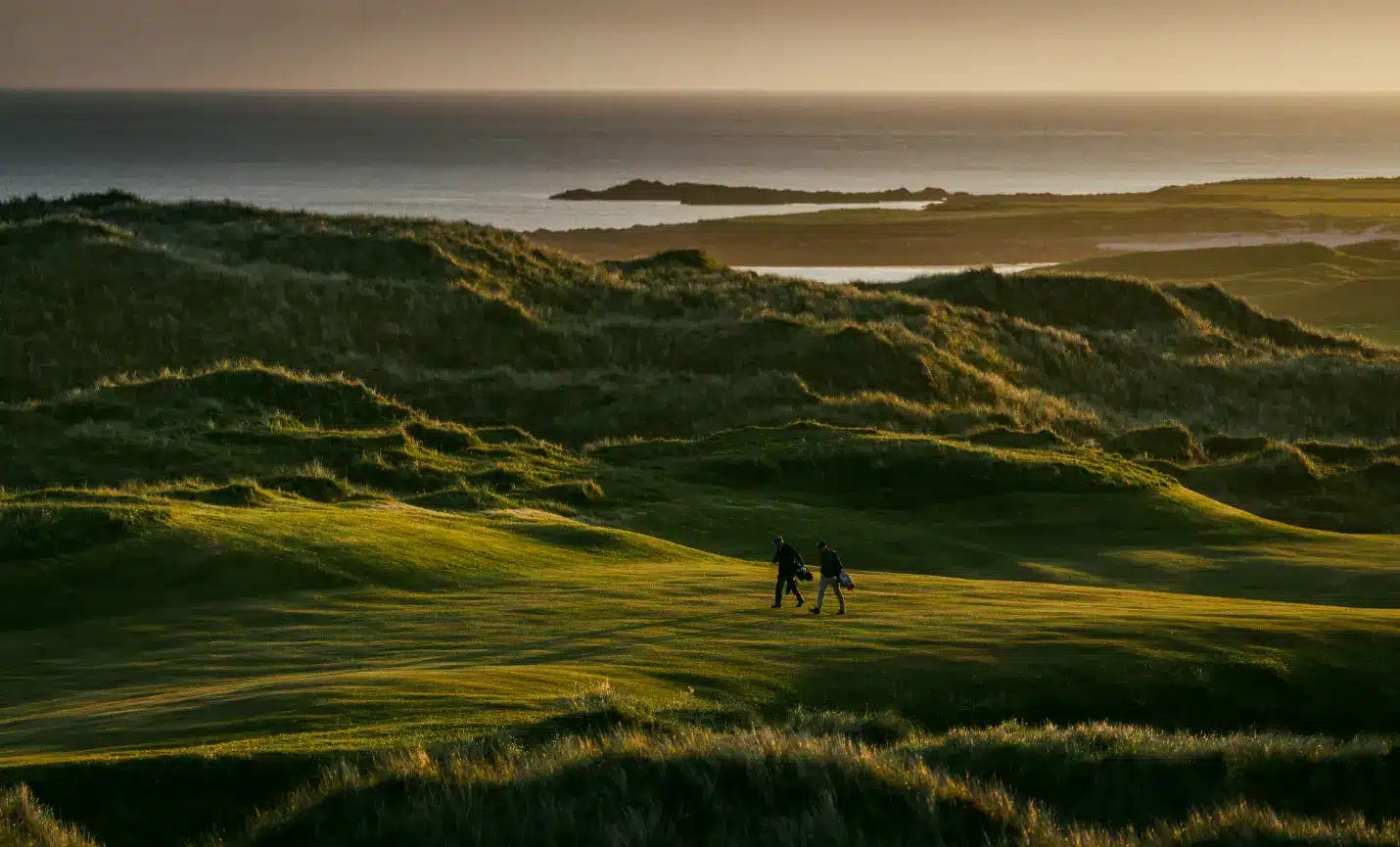
Carne was built in 1992 by an Irish golf architect called Eddie Hackett in possibly the most remote part of Ireland you can imagine on the Mullet peninsula in a Gaeltacht area of Ireland’s rugged west coast - next stop New York. Gaeltacht areas are those where the Irish language and culture is kept alive.
For years, Carne was like a secret, really only known to those who made the pilgrimage. And making the pilgrimage meant really making it — Belmullet is not on the way to anywhere. You go there because you are going there.
Then the lads from No Laying Up came to Ireland.
The Discovery
If you don’t know No Laying Up — they’re an American golf media company with a devoted following of serious golfers. They’re not the Golf Channel. They don’t do corporate. They act like scouts going out ahead to find the places that the general golfing public might not be aware of and they tell people about them honestly.
In 2019, they decided to check out this course in a remote part of Ireland called Carne.
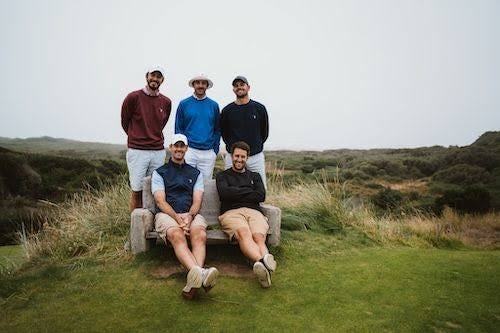
They fell in love with it and told their audience. Bookings went through the roof. Up until this point, people who knew about Carne loved it but golf is a crowded space so getting the word out there wasn’t easy. The lads from No Laying Up gave Carne the global platform it deserved.
Then Covid happened and the floor fell from under them.
How It Began
To understand why what happened next matters, you need to go back to the start.
A man called Michael had lived in London for years. When he came home to Ireland he bought some farmland in Mayo that came with a 17-part share of nearby grazing land called Carne Banks; this land was described as a sandy wasteland. Michael had never visited it.
One day he asked one of the other 16 owners to take him out there to show him this “sandy wasteland” that he was a part owner of.
They walked onto the land and Michael was blown away.
The dunes were enormous. He had never seen anything like them. Standing there on the edge of the Atlantic looking at this wild, improbable landscape, he had a thought.
I wonder could we build a golf course here?
He gathered with the 16 other land owners who agreed to Michael’s proposition and they approached Eddie Hackett — arguably Ireland’s leading golf course architect — and asked him what he thought. Hackett walked the land.
“These dunes have been here longer than humans. I’ll build a course here alright, but we’re not going to move any dunes”.
He built the course around the dunes rather than moving them. No big budgets. No heavy machinery. The community built it largely by hand and it opened in 1992.
Getting the word out was the problem. Mayo is a long way from anywhere. Carne is a long way from Mayo.
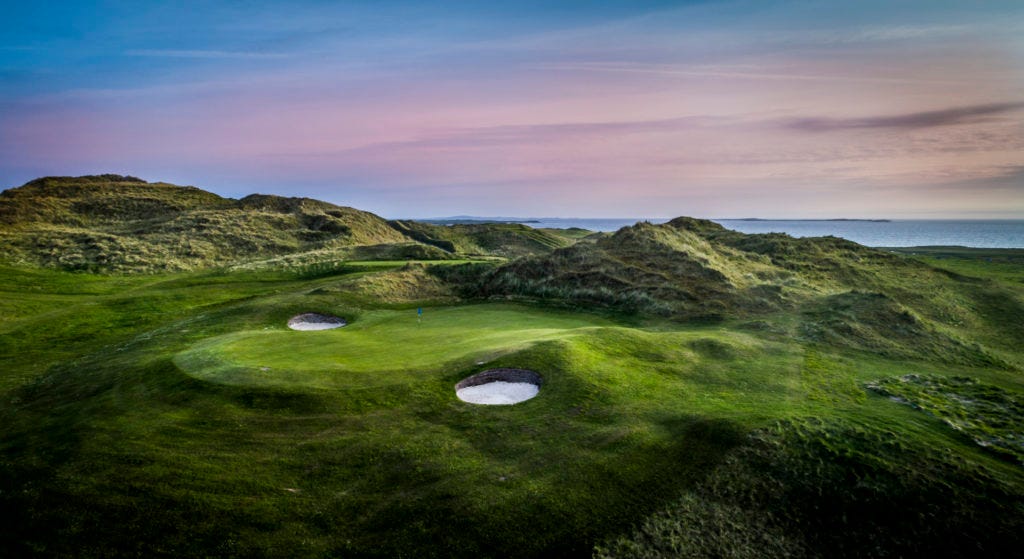
For years, it existed in the golfing underworld.
I remember seeing this Ted Talk from Simon Sinek a few years ago where he talks about how people are split into different categories.
You’ve got the “innovators” who are the ones who will Q outside the Apple store the night before when a new iPhone is released so they can buy it before anyone else. They don’t need to test it first, they pride themselves on being first. About 2.5% of the population are in this category.
Then you’ve got the “early adopters”, “early majority” all the way through to what he calls the “laggards” - these are the people who only buy a smart phone because you can’t get a landline phone anymore.
Simon Sinek called this split of the population, “The Law of Diffusion of Innovation”.
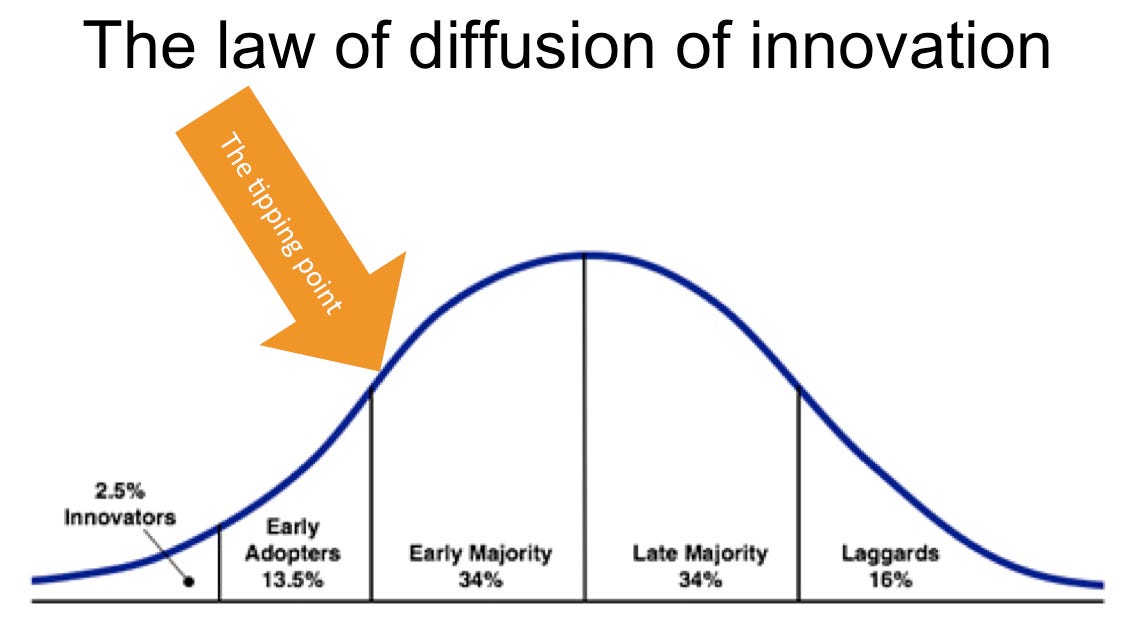
Up until the No Laying Up guys went to Carne, the only ones who played Carne were the “innovators” in Sinek’s language. But NLU introduced the “early adopters” and Carne’s tee sheet started filling up.
On Their Knees
Then along came Covid.
Just when Carne got their big break and was about to take off, everything stopped. The international visitors who had finally discovered Carne couldn’t travel. The momentum was gone overnight. Everything halted.
I didn’t know this story at all until last week when I played Carne for the first time.
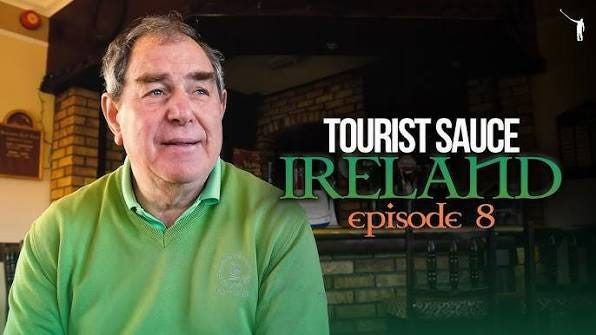
My friend Joe and I met Gerry, the chairman and Sarah, last year’s Lady Captain. The 4 of us, standing in the pro shop last week.
Gerry started talking with his Dublin accent, quiet pride, obvious love for the place. The kind of man who when he speaks instantly captures your attention.
Before No Laying Up found them, back in 2019, Carne was doing 2,500 rounds a year. At €65-€100 a round, you’re talking about €200k in annual revenue to maintain 27 holes of golf and a clubhouse on the Atlantic coast of Mayo.
The carpet in the clubhouse had seen better days. Replacing it wasn’t an option. Keeping the lights on was. In Gerry’s words - “we couldn’t afford to buy tea bags”.
“We were on our knees”.
Here you had a spectacular golf course on the edge of the world, built by the community, as a non-profit organisation but they were really struggling.
Gerry is from Dublin. He has no obvious reason to pour his life into a golf club in the far west of Mayo. He came to Belmullet on a holiday years ago and decided to stick around.
He fell in love with it and couldn’t look away - when you see Carne you can understand why.
Tom Coyne Makes a Call
Then Tom Coyne got in touch.
If you’re not aware of Tom Coyne, he’s the Editor of The Golfer’s Journal and has written multiple books including, “A Course Called Ireland” — Tom Coyne played a big part in sending a generation of American golfers on pilgrimages to remote Irish courses just like this one. He’s an overseas member of the club.
Tom knows what good looks like.
When Covid hit, Tom reached out to Carne - to check in on them really. He knew it was a special place and knew they would be struggling.
He asked Gerry if he’d write a diary - “a week during Covid managing a golf course”.
When Gerry came back with the diary, Tom was floored. He got back to Gerry and said, “you have to record a podcast of your diary”.
Gerry got his hands on a microphone and hit record. He talked about the course, the community, what it meant and what he and the team were facing during this pandemic. When you listen to this podcast (it’s about 25 mins) you will likely be floored too.
You can hear the emotion in Gerry’s voice. He talked about how they had to take the hard decision to let staff go from the clubhouse. The only people they could keep on the payroll were the green staff to make sure the course would be in good shape for when they re-open.
If they would re-open.
He talked about how Fergus, the head green keeper, had to take in the flags. Symbolic.
Would the place survive?
In the diary, Gerry talks about how emails were coming in every day of people having to cancel their tee times. Refunds and reschedules were being issued by Gerry and Fiona, the GM at the time. All their hard work and the boost they had received was wiped out overnight.
When the podcast went out, Tom Coyne asked the audience to help however they could. Buy a tee time. Buy something from the shop. Donate if they could afford it.
In the days after that podcast went out, Carne received over 6,000 emails.
Six thousand.
People booked tee times they couldn’t use. People bought merchandise. People sent donations with notes apologising that they couldn’t afford to give more. Carne didn’t have their pro shop online at the time but inquiries were coming in so thick and fast that they needed to get one up so people could buy stuff. They got the website up and running in a couple of weeks and the generosity of the world came through.
Gerry told me this as the 4 of us stood in the pro shop and I could see it still moved him. The outpouring of goodwill from strangers — most of whom had never set foot in Mayo — for a golf club they had mostly never visited.
We live in a world where we’re constantly bombarded with bad news and disasters but fundamentally I believe people are good and I think the reaction from people towards Carne shows that.
Not only did Carne survive Covid.
They got enough money to buy their new carpet.
What We Found
Joe and I drove out last week on a grey morning with dark clouds floating in off the Atlantic.
We stood on the first tee and looked out at dunes unlike anything I’ve seen on a golf course. Enormous, wild, rolling. The kind of landscape that makes you feel small in the best possible way.
At one point Joe disappeared over a dune and I didn’t see him again until the green.
That’s Carne.
You look at a course this raw and rugged and you could expect to make allowances. It would be quite reasonable if there were bumpy greens, patchy fairways — the inevitable compromise of maintaining somewhere this exposed on what had been a small budget.
But there are no allowances to make.
The greens were among the best in the country. We saw lads out working on the paths, improving small details. Taking pride in something that nearly didn’t survive.
In the pro shop I spoke with Sarah, last year’s Lady Captain and who looks after all their socials. You could feel her love for the place in every word she spoke.
It’s 2026. Carne has already sold 16,000 tee times for 2027. They’re not in debt to anyone. They have money in the bank. They can now do all the things they always wanted to do without asking whether they can keep the lights on.
A community golf club in Mayo — built by hand on ancient dunes, nearly killed twice, saved twice by people who loved it enough to tell others about it — is now one of the most sought after tee times in Irish golf.
As I walked upstairs in the clubhouse after the round, I looked down at the new carpet beneath my feet and smiled to myself.
My only regret is that we didn’t play it twice.
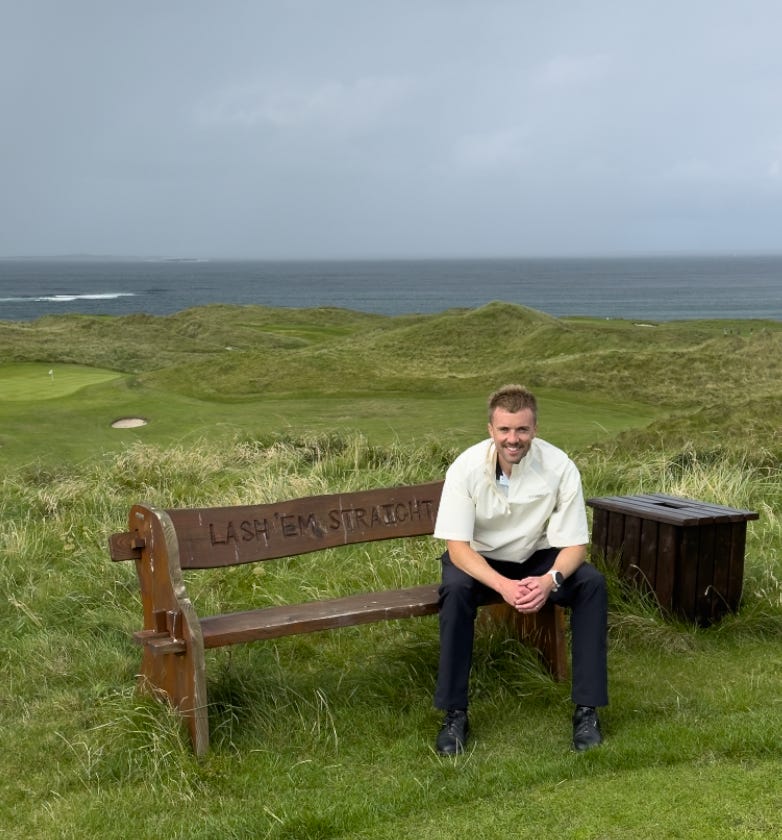
If you were ever thinking of going to play golf in Ireland and want to visit Carne the only thing I’d say is do it. You won’t regret it.
If you want us to organise it for you, email me at conor@roam-golf.com or check out our website here and fill out an enquiry. We’ll organise the whole trip for you.
People are fundamentally good. That’s my belief.
Go roaming.
The Caddie’s Line
Eddie Hackett designed over 60 golf courses in Ireland, often for rural communities with modest budgets. He is considered the father of Irish golf course design.
The Read
A Course Called Ireland by Tom Coyne who walked the entire coastline of Ireland playing every course along the way. A four-month long adventure and a 990-hole, 1,967,680-yard, Par 3,895 golf course ahead of him.
The idea, put simply, was to walk the entire coastline of the island of Ireland and play every golf hole along the way, making up what would eventually become A Course Called Ireland.
Eddie Hackett designed my local course too - Connemara Links. Love the place
Great piece Conor. Im pretty sure its Tom Coyne's favourite place.