
Can you actually cure the yips? It turns out yes.
My experience using a technique that treats the yips like PTSD for sport - and how it worked

On a dark winter’s evening in 2009, my Mam took me up to a golf shop. I was 16, it was a few weeks before Christmas and I had my heart set on a new 60 degree wedge.
I went straight to the wedge section and started taking practice swings with three or four different clubs, careful not to touch the ground so as not to damage the bottom of the club. I’d been in enough golf shops to know this unwritten rule.
I’d heard Cleveland make good wedges so I went with one of those.
We drove home from the golf shop that evening - My Mam, my sister, my mate Kev and I in the car and after we parked the car I took the wedge out of the boot, my Mam walked ahead into the house.
As I lifted my new 60 degree Cleveland wedge from the boot of her green Fiat Punto I heard her shout out “we’ve been done!”. My mate Kev and I looked at each other.
I didn’t know what she meant but when I walked into the kitchen I could see what she meant.
All the drawers in the kitchen were open, paper everywhere, the place was turned upside down.
The back door was wedged open, that must have been how they got in. It was just before Christmas so maybe these guys were panicking about not having any money to buy Christmas presents for their kids. Maybe they were just pricks.
My sister was pretty affected by it. We lived in a detached house on a hill. Slightly isolated so as that winter wore on, any time the wind howled or a door creaked she would panic. Understandable. We got an alarm and now the house has gates all around it, not quite Fort Knox but about as close as you can get for an average Irish home.
It wasn’t that I was unaffected by the experience but I just reasoned that they didn’t get much the first time so they were unlikely to come back.
I was about to have far greater issues.
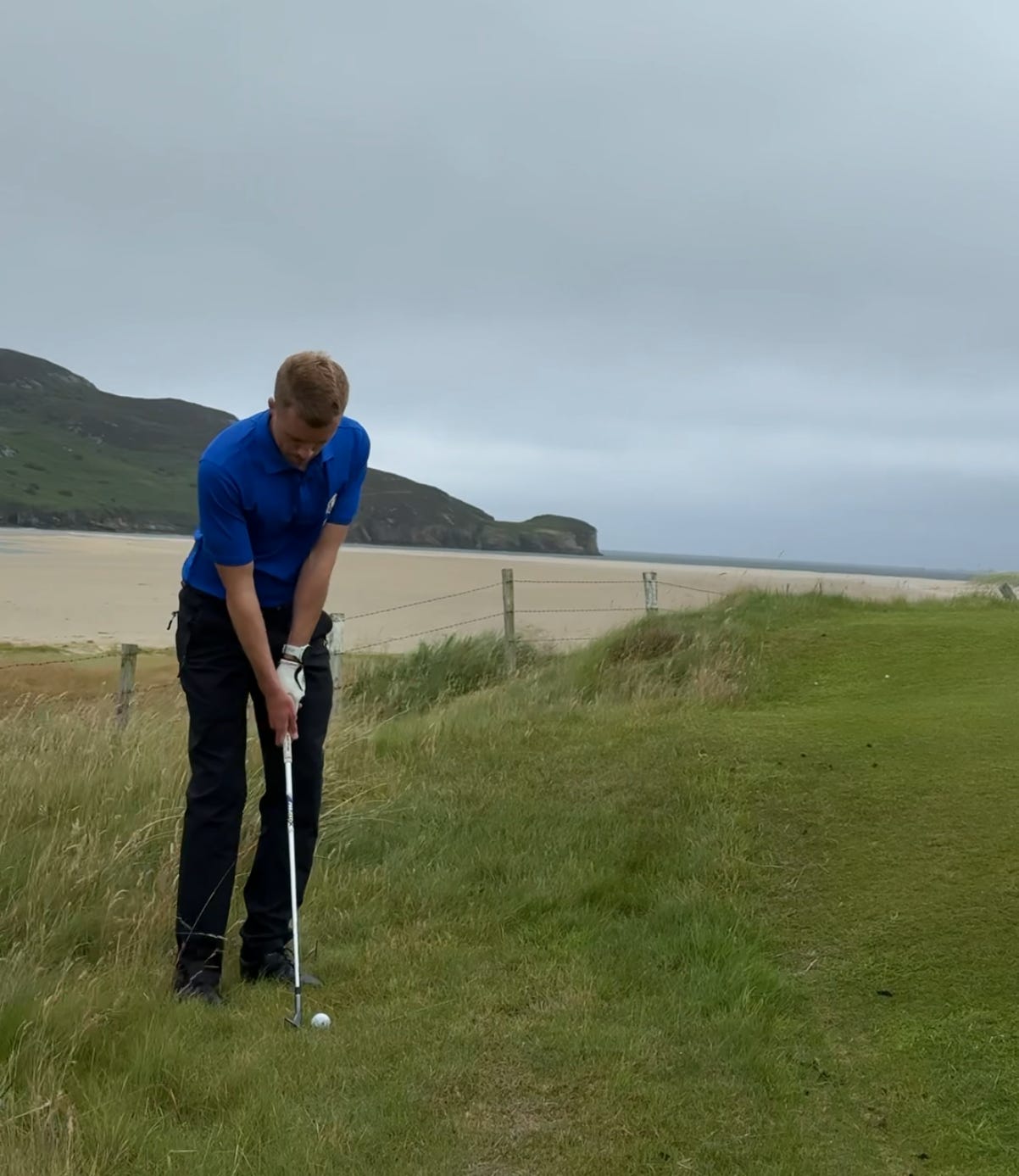
A few days later I was pretty excited when I got to take my new 60 degree out to the course. Chipping and pitching was my biggest strength. I loved it. I had played in the men’s club championship for the first time earlier that year and the guy who beat me in the 2nd round told me after our match that I probably had the best short game in the club. Maybe he was just being a gracious victor but I was proud of my ability around the greens.
That winter had been wet, pretty typical for Ireland. My first shot with this new wedge was to a tight pin over a bunker, the kind of shot my cocky 16 year old self relished.
I chunked it into the bunker in front of me. Hmmm that was weird I thought to myself.
I chunked the next one too and my mind started racing. “What’s going on here?”. I looked down at the club in search of some answers and saw 2 numbers - one said 60 and the other said 6. The 60 referenced the degrees of loft on the club which I was pretty familiar with. The 6 referenced something called the bounce, I’d never heard of it before. It turns out the less bounce a wedge has, the more it digs into the turf. Most wedges like this have 8-12 degrees of bounce. This only had 6.
Whatever it was, my head became scrambled. I thought, maybe I could ask Mam and Dad to get me a different wedge but straight away I shut off that idea - they had just got me a new wedge and now I wanted another one?
Deal with it, I thought to myself.
My greatest strength became my greatest weakness
But I didn’t deal with it. My greatest strength turned into my greatest weakness overnight. At that age we have a tendency to overthink. I would spend hours on the chipping green trying to get my old flare back but it was gone. Every time I stood over a chip my knees would buckle and the ball that once used to fly in the air and dance around the flag like a butterfly with sore feet was suddenly scuttling off the far side of the green or dying pathetically right in front of me as I’d either chunk or thin one. That lovely sound as I clipped the ball off the turf with spin was gone.
When I got my first job I saved up and bought 3 new vokey wedges - maybe that could fix me but now the damage had ingrained itself somewhere between my amygdala and hippocampus. The summer of when I was 18 I tried my hand at playing at Ireland’s elite amateur level but a 5 handicap with the chipping yips wasn’t going to make many cuts against the best young players in the country.
It went this way for years.
There was a round when I was level par playing the 16th, a reachable par 5 and I was greenside in 2, a chance to go -1 if I could get a simple up and down. I tried to be brave and take out the wedge when a putter would have been the percentage play. I thinned one off the far side of the green and turned a birdie into a bogey. I did the same on 18 and made a double, A round that should have been -1 turned into +3. Also ran.
This happened time and again.
I’d play a match for the club, come down the stretch neck and neck with my opponent only to have a poor chip hand the match to the other guy. I’d shake hands and feel a sense of deflation. “Just bloody chip the ball like a normal person”, I’d mutter to myself on the way to put my clubs in the boot of the car.
It affected my putting at times too with bouts of a rattlesnake coming down my right arm as I stood over a 3 footer. Anyone who has experienced it will know the feeling.
I resolved the putting (that’s a story for another day) but never the chipping.
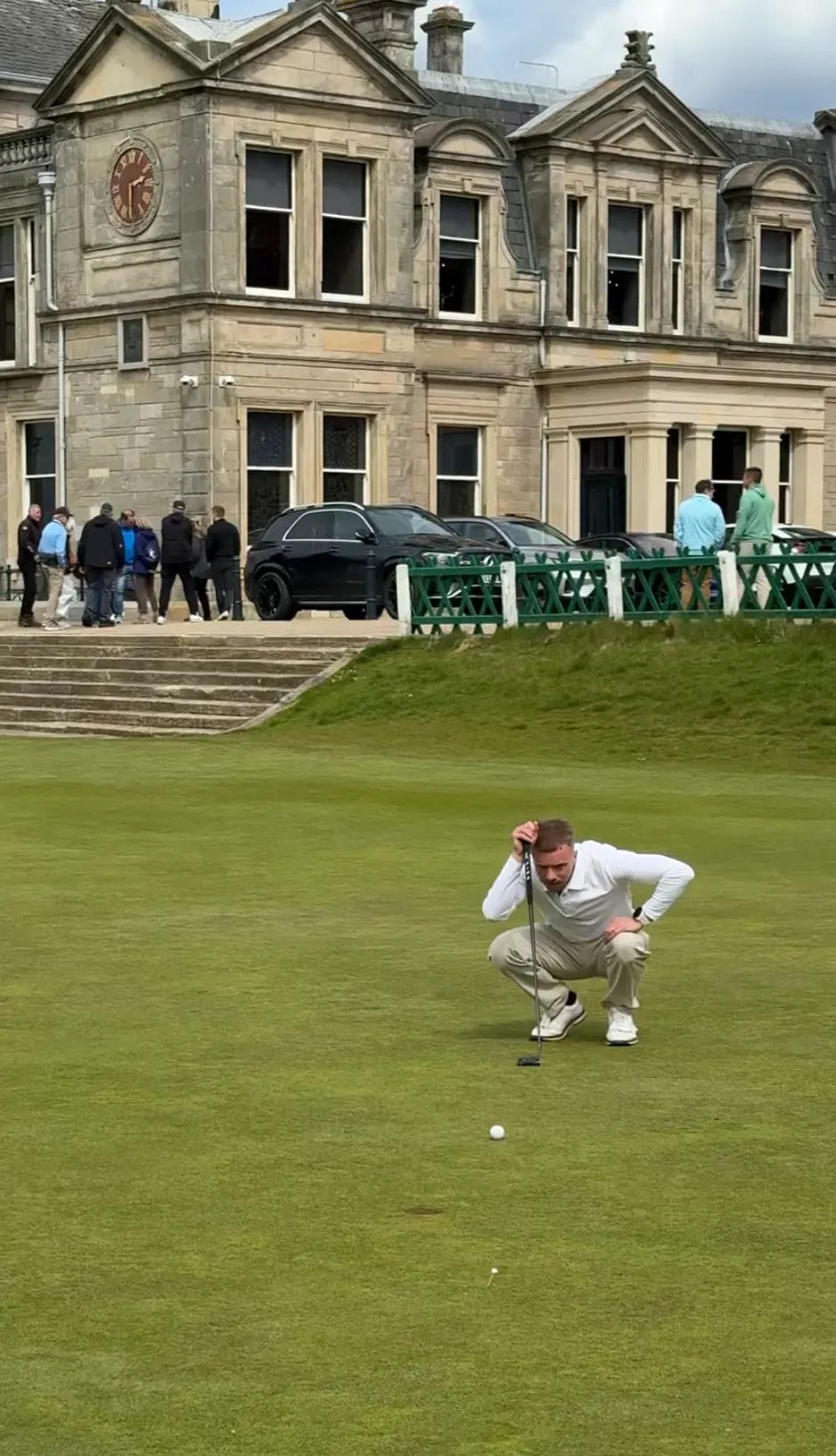
It became something I managed rather than cured. I was always comfortable with a flop shot for some reason. I think once there was speed involved I was immune. It was the delicate little chips that I couldn’t deal with. Still, I managed to maintain a handicap of 5 or 6 and even broke par once - 14 greens in reg and every time I missed a green that day I could take out the putter.
The £500 Zoom Call
One day I came across a guy on Instagram with the username “cure for the yips”. I watched everything I could on his profile and although he talked about curing people’s problems he never really showed how he did it.
Is this a charlatan or is this legit?
How could I believe this would work? He described himself as a “yips therapist”. I wasn’t aware they gave out degrees for such things…
I reached out to him to find out more about it.
£500 for a single session.
“Are you serious?” I thought to myself. He was in the UK and I’m in Ireland so my options were to travel to him or just take a zoom call. He said a Zoom call would suffice. £500 for a bloody Zoom call.
When I asked him about the price he said, “it’s tricky for me because I have no repeat customers - it’s so effective the first time”.
It was a good line but was it bullshit?
I was 32 at this point so the chipping yips had haunted me for 15+ years. Would I pay £500 to resolve it? Fucking right I would, I’d probably pay £2,000.
If it worked.
After a month or two of debating it in my own head I bit the bullet and booked the session.
Is this guy for real?
I sat in front of my computer and James appeared on the screen in front of me. After exchanging the usual Zoom call niceties we got down to it.
He explained the background of his work to me. “The yips is PTSD for sport and so we treat it using a technique that has been very effective for treating people with PTSD. A specific treatment called havening”.
The way he described it to me was that if you were in a shop one day and a robber came in wearing a t-shirt that read “I love Jesus” and held you up at gunpoint you’d probably be scarred after an experience like that - trauma for lack of a better way of putting it. The next time you saw someone wearing an “I love Jesus t-shirt” even if it was not in a threatening situation you’d break into a sweat and your heart would race. The previous experience is ingrained in your brain and your body reacts in a fight or flight type manner.
The same thing happens with sport. You have a bad experience at the wrong moment and it leaves a mark on you - it affects darts players, snooker players, baseball players and golfers. This “scar” on your brain manifests itself in these sports via an uncontrollable movement, usually in your arm or hand. Your subconscious mind takes over and overrides your conscious mind. Your arm jumps uncontrollably and you can’t override it with sheer willpower.
In the early 2000’s after years of after years of research into neuroscience and how trauma is encoded in the brain, 2 doctors in New York called Dr. Ronald Ruden and Dr. Steven Ruden came up with this technique that they called “havening” - it comes from the word ‘haven’, a safe place.
Their scientific explanation of the technique is that it “generates slow delta wave activity in the brain, which helps release neurotransmitters like serotonin and uncouple negative emotional responses from memories.”
My plain English understanding is that it was designed to help people with real world PTSD and helps unwire the part of your brain where the trauma has embedded itself. It’s almost like you’ve got this scar on your brain and havening removes the scar.
But the technique itself is kinda nuts.
On the Zoom call, James explained to me, “when we’re children, the way we’re comforted by our mother is they stroke our arm and say something like, it’s ok dear your mother loves you very much”. It’s soothing to us as babies and makes us feel safe when we’re scared.
Our brains are comforted by this.
Havening is basically the same thing but for adults. He asked me, “how do you feel when you’re standing over a chip with a tight lie over a bunker?” I replied, “I feel nervous, almost jumpy.”
“Ok good, now what I want you to do is cross your arms and start stroking the outside of your arms, almost like you’re giving yourself a hug”. I start doing this and he says, “ok you said you feel jumpy over a chip shot, start saying the word “jumpy” as you stroke your arms”.
Is this guy for real I thought to myself?
Well I’m here now I suppose, let’s just go with it.
I started stroking my arms and saying the word “jumpy”. This went on for a full 20 minutes. 20 minutes is a long time to repeat the word “jumpy” with your eyes closed while a stranger is watching you. You feel like a bit of an idiot. After a while I start laughing and say, “this is ridiculous” and James says, “yes, it is ridiculous”.
“Ok, now you’ve said you feel jumpy before you chip. When you were younger and your chipping was great, how did you feel?”.
“Well, I suppose I felt excited to hit a chip. Almost cocky, like I wanted to show off to my playing partners”.
“Great, so let’s stroke your arms again and say the word”excited “. And so we went again.
This went on for another 20-30 minutes. The session involved some more discussions but then after 90 minutes we said goodbye and I closed my laptop.
“That was nuts”, I said to myself shaking my head as I got up from my chair and back to the real world.
But I was strangely excited to get onto the golf course.
The following day
The next day I made my way out to Blainroe, my local course, with my cousin who I’d never played golf with before. He had no idea of my chipping yips or my £500 Zoom call from the evening before.
We played 11 holes and I shot -1. I missed 4 greens and got up and down every time. I flushed every pitch and chip shot - I nearly holed a shot from 50 yards over water.
What? Surely that did not actually work?
It did.
A few weeks later I was playing a tournament in Donegal, a 27 hole scratch cup. I stood on the last hole of the tournament +7 for the tournament on a tough golf course. That score might not sound all that great but go easy on me - for me this was good.
I was actually right in the mix to win the tournament. I was playing with the captain of the club and he had told me that +7 for the 27 holes had won the year before.
If I make a par, I could win it and a birdie would give me a serious chance. As I stood on the 18th tee my hands were shaking. I’d never won a scratch cup before.
I ripped a drive down to 40 yards short of the green. This 40 yard shot would be hell on earth for me a month prior but aside from the obvious nerves I didn’t feel the usual jumpiness that I normally felt over a shot like this.
I made a smooth swing and heard that beautiful sound you get when you clip a ball off tight links turf.
I looked up and saw the ball fly beautifully through the air and stop about 7 feet from the flag. Oh my God I thought to myself.

I missed the birdie putt - not a terrible putt it just didn’t drop but I walked into the clubhouse so pleased with myself, even though I didn’t make birdie. I was so proud of myself for the shots I hit on the last few holes but especially that pitch shot on the last.
I looked at the leaderboard - I actually lost by about 5 shots. I laughed to myself. In the end all those nerves were for nothing but I didn’t care. I hit the shot when the pressure was on. I hadn’t done that with a wedge in 15 years.
Last week, I played in the Captains prize and came to the last hole of the 36 hole tournament and had a pitch shot over a bunker from a tight lie. I nipped the ball nicely to 4 feet and holed the putt. Again, I didn’t quite win but I didn’t know that as I stood over the pitch.
That Zoom call was 12 months ago and my handicap has gone from 5.5 to 3.6. The chipping came back but so did my overall confidence. I had been stuck with this limiting belief about myself. Now I can play with the freedom of a 16 year old me. I know I’m never going to play on the PGA Tour and know that in a game like golf nothing is ever permanent.
You’re probably thinking - don’t get ahead of yourself Conor, and you would be right. The dreaded y word could return at any time and if it does, well then it does. But maybe I could beat it again.
But as of now, 12 months in the clear, I can stand over a 40 yard pitch with my hands shaking and back myself to hit a good shot. That feeling - after 15 years of not having it - is worth every penny of that £500 Zoom call.
If you’ve got the yips and want to find out more, here’s James’s website. I make nothing from sending you there. It just worked for me and maybe it could work for you too.
The Read:
Choke: What the Secrets of the Brain Reveal About Getting It Right When You Have To
By Sian Beilock
The Caddies Line: The yips is not nerves. Nerves you can breathe through. The yips takes over before your conscious mind has a chance to intervene. That distinction matters if you are trying to fix it - best not to try beat it with willpower. A technique like havening works better.