He spent 7 years as a POW then used visualisation to shoot a 76
The true story of Colonel George Hall, the man who visualised 3,000 rounds of golf in his head

This is one of the most unique stories I’ve ever come across. It starts in Vietnam in 1967.
The Vietnam War was a brutal war. It was also a strange war in many ways - I’m a bit of a history nerd and have done quite a bit of research into it, I’ve even been to the War Remnants Museum in Ho Chi Minh City. But even after all that I have a hard time wrapping my head around it all.
I’m not here to talk about the details of the war so I’ll stay in my lane. I’m sure you’re wondering what any of this has to do with golf.
A pilot, a parachute and a spot of bother
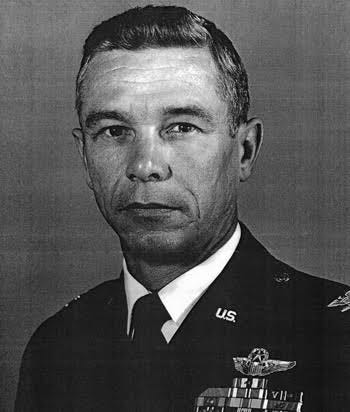
George Hall was a US Air Force pilot flying combat missions over North Vietnam in the late 1960s. He flew nearly 200 of these missions before one went wrong. His aircraft was hit and he ejected out of his plane into the Vietnamese sky.
As he floated down to the ground he probably knew he was in a spot of bother. Touching down into jungle and fields where your enemy knows the land and you don’t - the odds of getting back to safety were low. He was captured quickly.
The Vietnamese didn’t kill him. Instead, George spent the next seven years in a prisoner of war camp known as The Hanoi Hilton - one of the most brutal POW camps of the Vietnam War.
His cell was six feet tall, which didn’t allow him to stand up straight. He was given one bowl of dirty rice a day and water that probably wasn’t clean enough to put your hands in. The water actually came in a bucket and when he drank the water from the bucket, he had to use that same bucket to go to the toilet in. At the end of each day, he would hand the bucket out to the guards and the next day the bucket would return with some water.
Solitary confinement. No comforts. No contact with the outside world for months at a time.
As you can imagine, the prisoners of war were often tortured. George experienced a particular form of torture involving his arms being tied behind his back in such a way that his shoulders would pop out of their sockets.
Brutal stuff that can be hard to wrap my head around as I sit in the comfort of my chair.
Back home, his wife and children had no idea whether he was dead or alive. His wife kept the faith - she told the kids he was coming home one day. Three and a half years after he had been reported missing, she walked into her son’s classroom with the school principal. She was carrying a letter from his father.
He was alive.
What he did to survive
But George Hall was also a golfer.
It’s hard to know how any of us would handle what he was going through. George handled it in a very particular way.
Every single day in that cell, George would lie flat on his back, close his eyes, and walk up to the first tee of one of his favourite courses back home. He had been a 4 handicap golfer at Hattiesburg Country Club in Mississippi and had also played courses like Pebble Beach. In his mind he would step up to the tee at Hattiesburg Country Club or Pebble Beach, pull the headcover off his driver, reach into his pocket for a tee, press it into the ground, place the ball on it and hit his opening tee shot. Sometimes it went straight up the middle. Sometimes it didn’t.
From there he played the full round.
Not a vague imagining. A complete, meticulous, sensory round. Every blade of grass. The grip of the club in his hands. The sound of the ball leaving the face. He walked step by step in his mind to wherever his ball had landed. He visualised parking the car before the round, walking into the pro shop, meeting his friends on the putting green and asking them to join him on the course.
After a while of this, George managed to smuggle a stick into his cell to use as a golf club. He would swing it, pace out the 240 yards in his cell that he usually hit his driver, hit his next shot, and walk to his ball again.
He didn’t imagine himself playing with Jack Nicklaus or Arnold Palmer. Just his friends. He didn’t exaggerate his scores - no eagles, not many birdies. Mostly pars.
“Just a pleasant round of golf with friends,” he said afterwards.
Over seven years he played approximately 3,000 rounds of golf in his mind.
I don’t know about you but I’ve tried visualisation in the past. I usually get distracted after about 30 seconds. What George Hall did was something else entirely. All from a tiny cell in Vietnam.
He did this every day for 89 months.
Coming home
When Operation Homecoming secured the release of American prisoners in 1973, Hall was liberated from The Hanoi Hilton and brought back to America.
He was frail and emaciated having lost 100+ pounds and needed two canes just to walk.
A few weeks into his rehabilitation, he decided today was the day he was going to the golf course. Despite his still frail state he wanted to live out the reality of what he had visualised so often in his mind. Playing a round of golf.
When he arrived at the course with his family, a small crowd gathered to watch him tee off. George was a war hero and although there were mixed feelings among the American public about that war and the men who fought it, there was a respect for George, a recognition of what he had gone through as a POW.
George didn’t warm up and hit 100 golf balls like the pros do before a round of golf. He just walked up to the 1st tee.
George stood up on that first tee and took out his 3 wood, not his driver. He took a couple of practice swings and flushed it right up the middle of the fairway. His first swing in 7+ years - right up the middle. He walked up to his ball, hit it up near the green and made a bogey.
Now - here’s where I need to be honest about something.
The reason I originally sat down to write this piece was because I’d heard this story about George Hall - the Vietnam POW survivor who came back to play his first game of golf after being at The Hanoi Hilton - who walked those 18 holes on two canes and shot four over par 76. I read three or four articles that repeated that score. And I wrote that as a draft.
But I always try to do a lot of research before I publish anything - I don’t exaggerate anything, I want to be as accurate as I can be. I was driving to work yesterday listening to a podcast interview with George Hall’s son.
Then I kept listening and the son told me the rest of the story.
His son said the accounts of that first round have been slightly exaggerated over the years the way stories tend to be. He did shoot a 76 with zero 3 putts six weeks after coming home but there’s some nuance.
The real story was that first day he played was 9 holes , shot about 4 or 5 over for 9 holes (which is unbelievable) and then a week or two later played his first full round back and shot an 81.
The 76 came a couple of games later.
That story goes like this.
On March 21, 1973, within six weeks of his release, Colonel Hall was invited to play in the 1973 Greater New Orleans POW Pro-Am Open, where he unbelievably shot 76, true to his former handicap of four. Right after his round the press asked him if his incredible score was down to a case of reentry luck. Col Hall smiled and replied, “Luck, are you kidding? I never three-putted a green in all my 7 years of practice.”
When I heard that my heart sank a wee bit - here was me about to write this story about a guy who shot 76 on his first round back. I nearly didn’t write the piece when I found that out.
Then I stopped and thought about how ridiculous that was.
The man spent seven years in a Vietnamese prisoner of war camp. He came back weighing roughly 100 pounds less than when he left. He needed two canes to walk. He hadn’t touched a golf club in over seven years.
And in his first 2 full rounds back he shot 81 then 76. Unbelievable. Not by hitting lots of golf balls or practising his putting. All just by using visualisation.
Incredible
What he was actually doing
On one hand, this is just a remarkable story about a man who lived an extraordinary life. Not a life any of us would choose but here was a man who could have gone insane. George Hall had every right to consider himself a victim but he chose to take a stance with the only thing he could still control - his mind.
On the other hand, from a golf performance perspective it shows how powerful your mind is. George Hall’s story has been used by mental game coaches as an example of how powerful visualisation can be.
People will often say things like, “golf is 90% mental” which is likely true but what does that actually mean?
I’m not a fan of vague statements like that - give me something I can actually use. So what I love about this story is understanding the details of what George Hall actually did. He played a full round of golf in his mind, which took him 3-4 hours at a time. I’m not saying we can all spend 4 hours a day on visualisation but there’s definitely something we can take from his story.
I’m certainly no neuroscientist but from what I understand, the science behind what Hall did is well documented. The brain doesn’t fully distinguish between a vividly imagined experience and a real one. When you visualise something in enough detail - engaging all the senses, running through it in real time - your mind activates the same neural pathways as if you were actually doing it, which is a bit mad when you think about it.
My understanding is, to do this properly you don’t just quickly visualise yourself hitting a shot - you should visualise the whole experience. Walking up to your ball, getting a feel for the wind direction, choosing what club to hit, following your full routine.
I’ve heard Padraig Harrington say that after he won his first Open Championship in 2007 he had pictured himself lifting the Claret Jug during his final round. He had made himself believe it was going to happen before it did.
The story of George Hall is a remarkable one. Hopefully if you’re reading this you won’t have to go through an experience like his but if you get a spare 10 minutes for a few days before your next game of golf, try sitting down on a chair and visualising what you want to do in your next round of golf. Do it 3 or 4 times and see what happens…
The Caddie’s Line
Visualisation is used by virtually every elite athlete in the world. Tiger Woods has spoken about visualising shots since childhood. Muhammad Ali famously said “I am The Greatest” before he ever was. He would visualise every fight before he stepped into the ring. What George Hall did in that cell - running through rounds in real time, engaging every sense, not skipping a single step - is the most extreme documented example of the practice producing measurable results.
The Read
Golf is Not a Game of Perfect by Bob Rotella. Dr Bob Rotella has become one of the most famous sports psychologists in the world and his players have won a total of 75+ majors, both male and female. His players include Padraig Harrington, Rory McIlroy and Ernie Els.
Before you go - if you want to come and play some of the best courses in Ireland with me, I'm hosting a few small events over the next few weeks in Wicklow. Win your event and the golf is on me at Rosapenna, Carne, Druids Glen or Killeen Castle. Nine spots per event - check them out here: